

Zambian or Colombian emerald: how they differ and how to choose
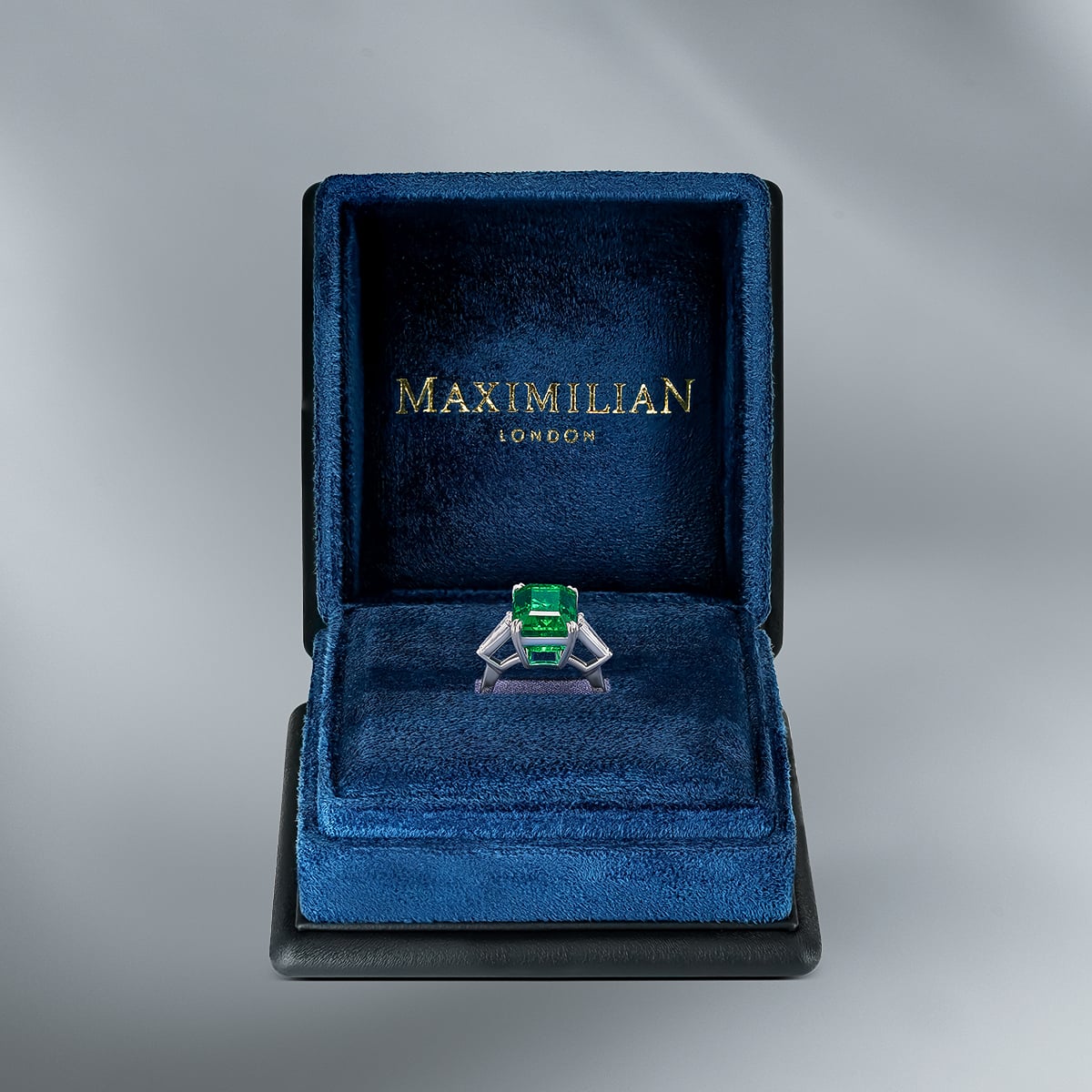
Neither origin is better by definition: every emerald mine produces a wide range of quality, so the individual stone decides. Colombian emeralds form in black shales and limestones without pegmatites; Zambian emeralds form where pegmatites meet talc-magnetite schist and are rich in iron, which can give them a bluish tint. Because appearance overlaps between sources, origin is a matter for a gemmological laboratory's opinion, not for the eye.
One gem, two very different births
Emerald is the green to bluish green variety of the mineral beryl. Its green comes from trace impurities of chromium and/or vanadium, and in GIA's words, iron gives the stone a bluish tint.
Colombia and Zambia both produce this same gem, and Zambia's Kafubu area is well known as one of the largest emerald-producing areas in the world. What separates them is the rock in which each formed.
Colombia: emeralds born in black shale
Colombian emeralds occur in veins, pockets and breccia within an Early Cretaceous succession of black shale and limestone. GIA describes these rocks as rich in organic matter and notes that the emeralds form there without the benefit of pegmatites.
The fluids that deposited them were basinal brines that interacted with evaporites. Three-phase inclusions in Colombian emeralds contain tiny crystals of rock salt, liquid and a bubble of gas.
Zambia: emeralds born in schist
Gem-quality Zambian emeralds are found in north-central Zambia, near the Kafubu River, about 45 km southwest of Kitwe in the Copperbelt Province. The deposits lie in the Ndola Rural Restricted Area.
Here emerald mineralisation occurs at the phlogopite-biotite contact zone between pegmatites and a talc-magnetite schist. At Kagem, considered the world's single largest emerald mine, the rock sequence consists of talc-magnetite schist, amphibolite and quartz-mica schist.
Colour: what iron changes
Unlike Colombian emeralds, emeralds from Zambia are rich in iron and have a higher refractive index and specific gravity. Iron gives emerald a bluish tint, while chromium and vanadium make an intense green, so iron can contribute to the bluish green often seen in Zambian stones.
Bluish green is not a lesser colour. According to GIA, the most desirable emerald colours are bluish green to pure green, with vivid saturation. Both origins can reach that range.
Inside the stone: inclusions
Fluid inclusions in Zambian emeralds are typically blocky or irregularly shaped multiphase inclusions, whereas Colombian emeralds are known for three-phase inclusions with tiny crystals of rock salt.
Such features guide a gemmologist, but they are not exclusive to either country: three-phase inclusions are also seen in emeralds from other countries, including Zambia's Musakashi area.
Why the eye cannot tell origin
GIA states plainly that emerald appearance overlaps between sources. A stone cannot be called Colombian or Zambian from its colour alone.
Laboratories combine several kinds of evidence. At SSEF, origin determination relies on the analysis of microscopic features, trace element concentrations and spectroscopic data. GIA offers an identification report with geographic origin added for natural emerald.
Clarity enhancement applies to both
Filling emeralds with substances that enhance their clarity is a common practice in the trade, whatever the origin. Surface-reaching fractures are sometimes filled with oils, waxes or artificial resins.
A GIA Colored Stone Identification Report or Colored Stone Identification & Origin Report confirms whether an emerald has been treated.
How to choose
Every mine produces a wide range of quality. A fine Zambian emerald and a fine Colombian emerald are both fine emeralds; the comparison that matters is between two individual stones, not two countries.
GIA evaluates emerald but does not grade it, so the choice rests on the stone seen in person and on what its report states.
- Colour first: bluish green to pure green, with vivid saturation.
- Origin: a laboratory opinion if the stone is described as Zambian or Colombian.
- Treatment: whether the stone is filled, as stated in the report.
- The individual stone over the name of the country.
Questions
Which is better, a Zambian or a Colombian emerald?
Neither by definition. Every emerald mine produces a wide range of quality, and the most desirable colours, bluish green to pure green with vivid saturation, can come from both. The choice rests on the individual stone, together with what its laboratory report states about identity, treatment and origin.
Are Zambian emeralds high quality?
Zambia's Kafubu area is well known as one of the largest emerald-producing areas in the world, and Kagem is considered the world's single largest emerald mine. As with any source, quality varies from stone to stone.
Why do Zambian emeralds often look more bluish?
Zambian emeralds are rich in iron, and iron gives emerald a bluish tint. Chromium and vanadium produce the intense green.
Can I tell a Zambian emerald from a Colombian one by eye?
No. Emerald appearance overlaps between sources. A laboratory forms its origin opinion from microscopic features, trace element concentrations and spectroscopic data.
Sources
- Emerald Description (GIA)
- Seeing Green: emerald colour (GIA)
- Emerald Quality Factors (GIA)
- Emerald Buyer's Guide (GIA)
- Emerald Gem Overview (GIA)
- Photoluminescence Spectra of Emeralds, Gems & Gemology (GIA)
- Emeralds from the Kafubu Area, Zambia, Gems & Gemology (GIA)
- A Visit to the Kagem Open-pit Emerald Mine in Zambia (GIA)
- Geographic Origin Determination of Emerald, Gems & Gemology (GIA)
- Geology of Corundum and Emerald Gem Deposits: A Review, Gems & Gemology (GIA)
- In Rainier's Footsteps: Journey to the Chivor Emerald Mine, Gems & Gemology (GIA)
- Colombian Trapiche Emeralds: Recent Advances in Understanding Their Formation, Gems & Gemology (GIA)
- Analytical Methods for Gemstone Geographic Origin Determination, Gems & Gemology (GIA)
- Gem Treatment (GIA)
- Colored Stone Reports (GIA)
- Does GIA Grade Emerald? (GIA)
- Can I Buy an Untreated Emerald? (GIA)
- Emerald (SSEF)
