

Paraíba tourmaline: what the gem is and why it is prized
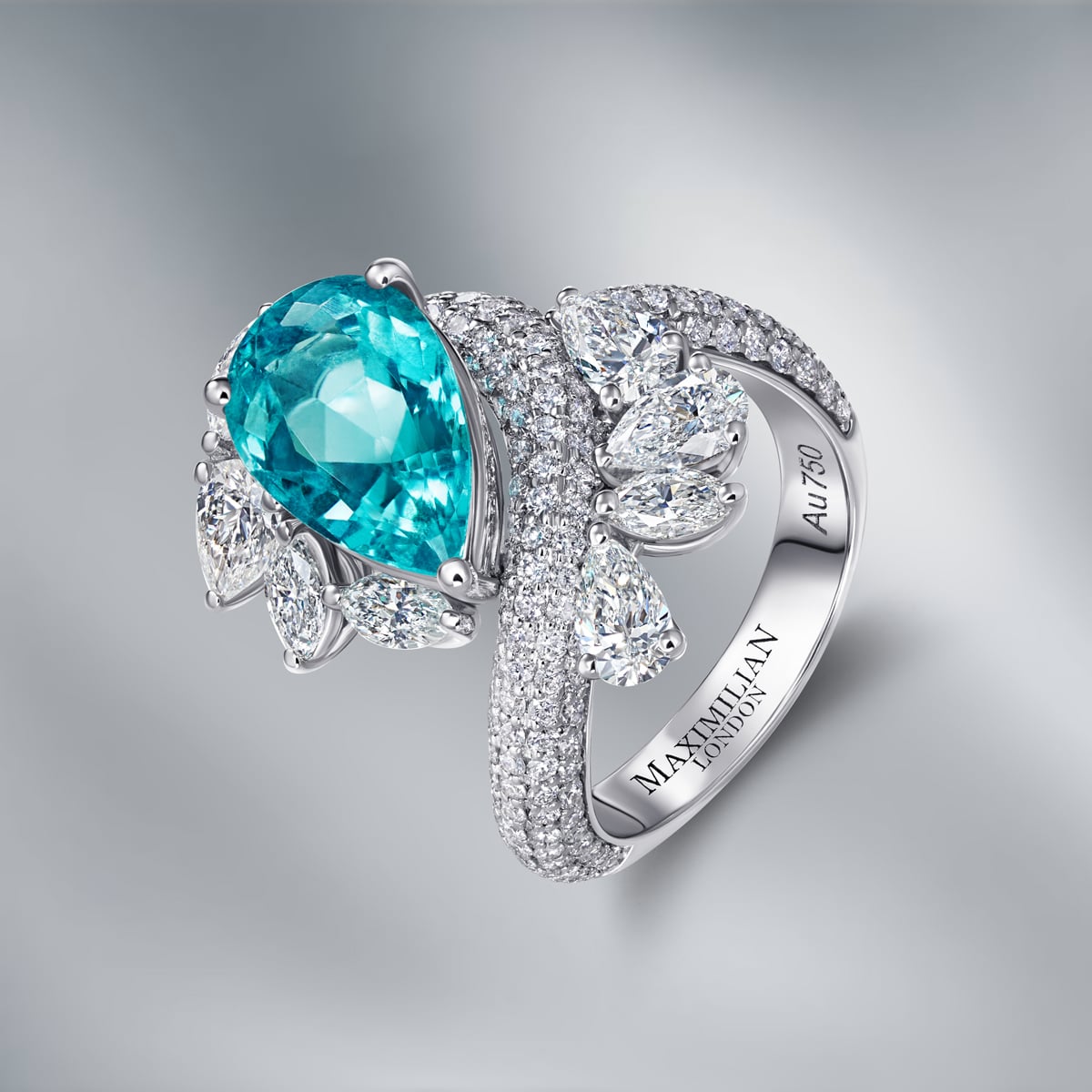
Paraíba tourmaline is a copper-bearing tourmaline, usually of the species elbaite, discovered in the Brazilian state of Paraíba in the 1980s. Its standing rests on what the gemmological literature documents: a vivid blue caused by copper, production that has been sporadic since the first finds, and the rarity of stones above one carat. With this gem, colour is the key factor, not size.
A discovery of the 1980s
The gem is young by the standards of the jewellery world. A vivid neon blue to greenish blue tourmaline, coloured by copper and manganese, was discovered in Brazil in the 1980s. GIA publications place the initial discovery in 1982 and the finding of the first deposit, at Mina da Batalha, in 1987.
The stones first appeared on the international gem market in 1989 and attracted great interest from the start. The variety name is derived from the Brazilian locality where the gem was first mined: the workings lie near São José da Batalha in Paraíba State. At least two further localities in neighbouring Rio Grande do Norte State have produced limited quantities of the same copper-bearing tourmaline.
What the gem is
Tourmaline is not a single mineral but a supergroup with more than 40 recognized species. Paraíba-type stones are usually elbaite, although liddicoatite examples also exist.
What sets the variety apart is its chemistry. The bright blue colour characteristic of Paraíba tourmaline is caused by copper, and SSEF notes that in the best case copper gives rise to a vivid blue. Other chromophores, such as manganese and iron, contribute to the wider range of colours seen in copper-bearing tourmalines.
The definition widely accepted in the gem industry and at GIA is built on these two things, appearance and cause. It covers blue (electric blue, neon blue, violet blue), bluish green to greenish blue, and green (or yellowish green) tourmaline of medium-light to high saturation and tone, coloured mainly by copper and manganese.
Why colour comes first
In tourmaline generally, GIA notes that highly saturated colours without dark areas are the most valuable. Paraíba tourmaline is the clearest example of that rule. GIA's guidance on the gem is brief: with Paraíba, colour is the key factor, not size.
For a collector this changes the order of the usual questions. The hue and the strength of the colour are judged first, and the weight of the stone is considered only afterwards.
Why it is rarely seen
Production from the original Brazilian deposits has been sporadic since the initial discovery, as a GIA study of those deposits records, and the neighbouring localities are described as yielding limited quantities.
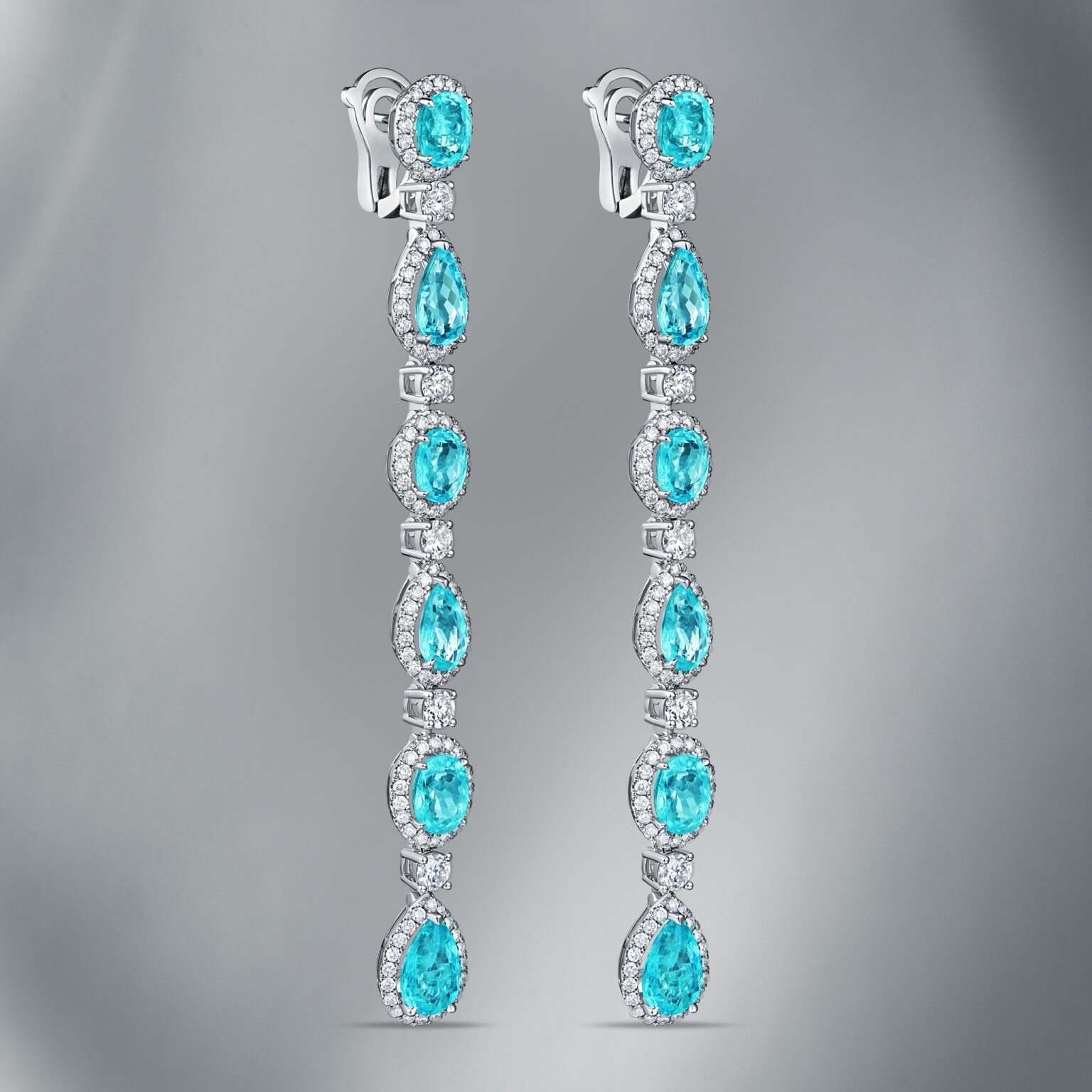
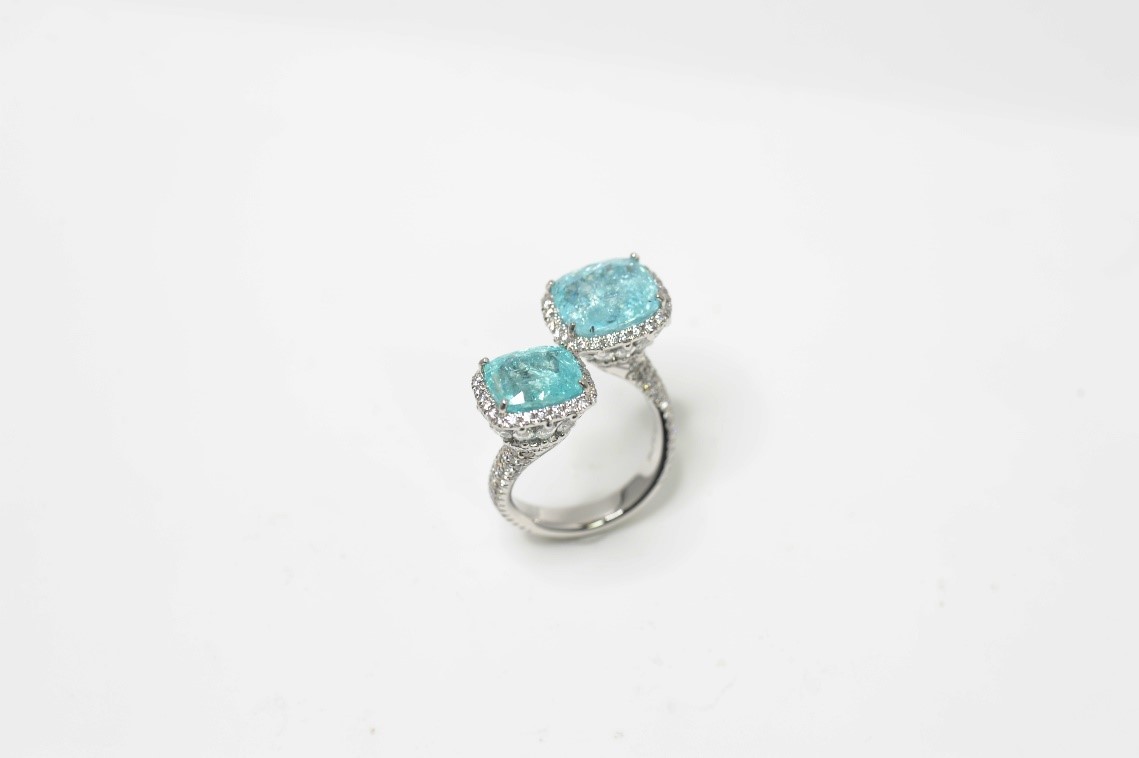
Size is the second constraint. According to GIA, Paraíba tourmaline is rarely seen in sizes bigger than one carat. A stone that combines a saturated colour with a weight of several carats is therefore uncommon and particularly noteworthy in high jewellery.
Beyond Brazil: Nigeria, Mozambique and Ethiopia
Since 2001, copper-bearing tourmaline from western Nigeria, very similar to the Brazilian material, has been available in the market. Copper-bearing tourmaline from Mozambique was first recovered in 2001, although its copper content was not recognized until 2003. GIA notes that the discovery of significant deposits in Mozambique increased availability. More recently, GIA and Gübelin Gem Lab confirmed the emergence of an important new source of copper-bearing tourmaline in Ethiopia.
The accepted definition applies to such stones whatever their geographical origin, and the laboratories of the Laboratory Manual Harmonisation Committee have standardised the nomenclature they use to describe a Paraíba tourmaline. Paraíba is therefore a variety name rather than a statement of where a stone was mined.
Origin can still be investigated. Saturated blue-to-green stones from Nigeria and Mozambique cannot be distinguished from Brazilian material by standard gemological testing, but quantitative chemical data obtained by LA-ICP-MS show that tourmalines from the three countries can be differentiated. Generally, Paraíba tourmaline from Brazil is characterized by higher concentrations of copper and zinc.
Clarity, cut and treatment
Inclusions are part of the nature of tourmaline. The most typical resemble thread-like cavities parallel to the length of the crystal, and one Paraíba tourmaline examined by GIA showed thread-like fluid inclusions, growth tubes and many fractures. Cut matters as it does for every coloured gem: the quality of the cut, like the other quality factors, affects value.
Heat treatment belongs to the story of this gem. In a GIA study of the Mozambique material, heating all but the green to yellowish green stones typically produced Paraíba-like blue-to-green hues. Fractures may also be filled, and GIA observes that in tourmaline fracture filling is generally the only treatment that leaves visible evidence.
What a laboratory report adds
Because the name rests on chemistry and because treatment is seldom visible, a laboratory document carries real weight with this gem. A Paraíba tourmaline can be submitted to GIA for a Colored Stone Identification & Origin Report.
Reports also address heating. SSEF, for example, states that if a stone shows indications of heat treatment, its report mentions "indications of heating". We advise consulting the laboratory report alongside the description of the gem: it records the laboratory's identification, any opinion on geographic origin, and treatment findings where these can be established.
Wearing and care
Tourmaline ranks 7 to 7.5 on the Mohs hardness scale, which makes it suitable for jewellery that is worn with consideration.
GIA notes that high heat can alter the colour and that sudden temperature change can cause fracturing. Any workshop repair involving heat should therefore be entrusted to a jeweller who knows the stone.
Questions
What is Paraíba tourmaline?
It is a copper-bearing tourmaline, usually elbaite, of blue, bluish green to greenish blue, or green colour, coloured mainly by copper and manganese. It was discovered in the Brazilian state of Paraíba in the 1980s.
Why is Paraíba tourmaline so rare?
Production in Brazil has been sporadic since the initial discovery, and according to GIA the gem is rarely seen in sizes bigger than one carat.
Does Paraíba tourmaline come only from Brazil?
No. Copper-bearing tourmaline is also known from Nigeria and Mozambique, and GIA and Gübelin Gem Lab have confirmed a new source in Ethiopia. The accepted definition applies whatever the geographical origin.
Is Paraíba tourmaline heat treated?
It can be. In a GIA study of Mozambique material, heating typically produced Paraíba-like blue-to-green hues in all but the green to yellowish green stones. Laboratories such as SSEF mention indications of heating on their reports.
Sources
- An Update on “Paraíba” Tourmaline from Brazil, Gems & Gemology (GIA)
- Gem-Quality Cuprian-Elbaite Tourmalines from São José da Batalha, Paraíba, Brazil, Gems & Gemology (GIA)
- Field Gemology: Building a Research Collection, Gems & Gemology (GIA)
- Geographic Origin Determination of Paraíba Tourmaline, Gems & Gemology (GIA)
- “Paraíba”-Type Copper-Bearing Tourmaline from Brazil, Nigeria, and Mozambique: Chemical Fingerprinting by LA-ICP-MS, Gems & Gemology (GIA)
- Copper-Bearing (Paraíba-Type) Tourmaline from Mozambique, Gems & Gemology (GIA)
- Cat’s-Eye Brazilian Paraíba Tourmaline, Gems & Gemology (GIA)
- Tourmaline in Paraíba Tourmaline, Gems & Gemology (GIA)
- Chemical Analysis in the Gemological Laboratory: XRF and LA-ICP-MS, Gems & Gemology (GIA)
- Tourmaline Traits and Inclusions (GIA)
- Tourmaline Quality Factors (GIA)
- Tourmaline Buyer’s Guide (GIA)
- Tourmaline Care and Cleaning Guide (GIA)
- Colored Gemstone Value Factors (GIA)
- Does GIA Grade Tourmaline? (GIA)
- The Colour Range of Paraiba Tourmalines (SSEF)
- Paraiba Tourmaline (SSEF)
- Information Sheets (Laboratory Manual Harmonisation Committee)
- GIA and Gübelin Gem Lab Confirm New Source of Copper-Bearing Tourmaline from Ethiopia (Gübelin Gem Lab)
