

"Paraíba diamond": why the name points to a tourmaline
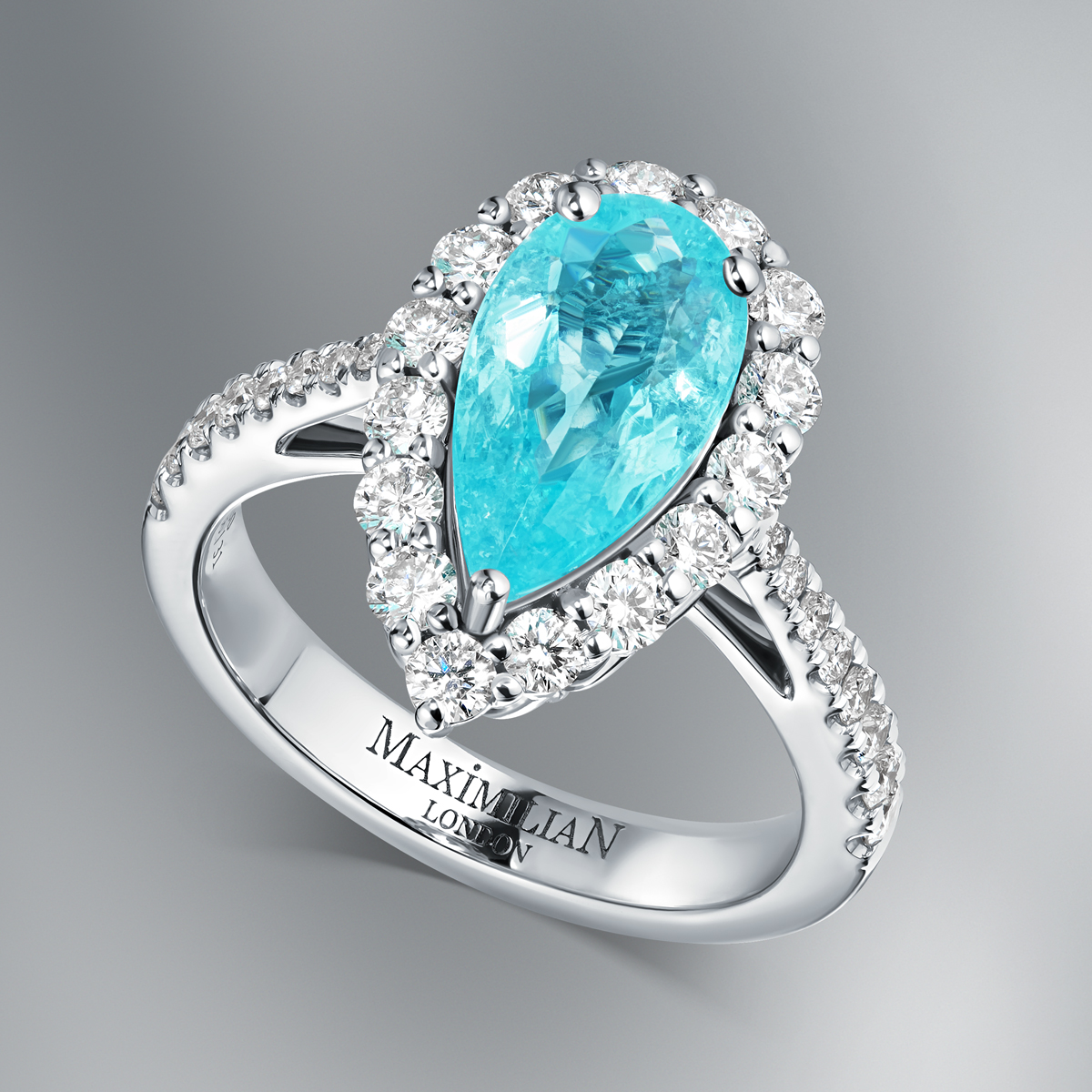
Paraíba is a copper-bearing variety of tourmaline, not a type of diamond. The name comes from the Brazilian state where the gem was discovered in the late 1980s. A stone described as a "Paraíba diamond" should be read with care: the definition accepted at GIA and in the gem industry applies to tourmaline, and diamond is a separate mineral with its own chemistry, structure and hardness.
A phrase that joins two different gems
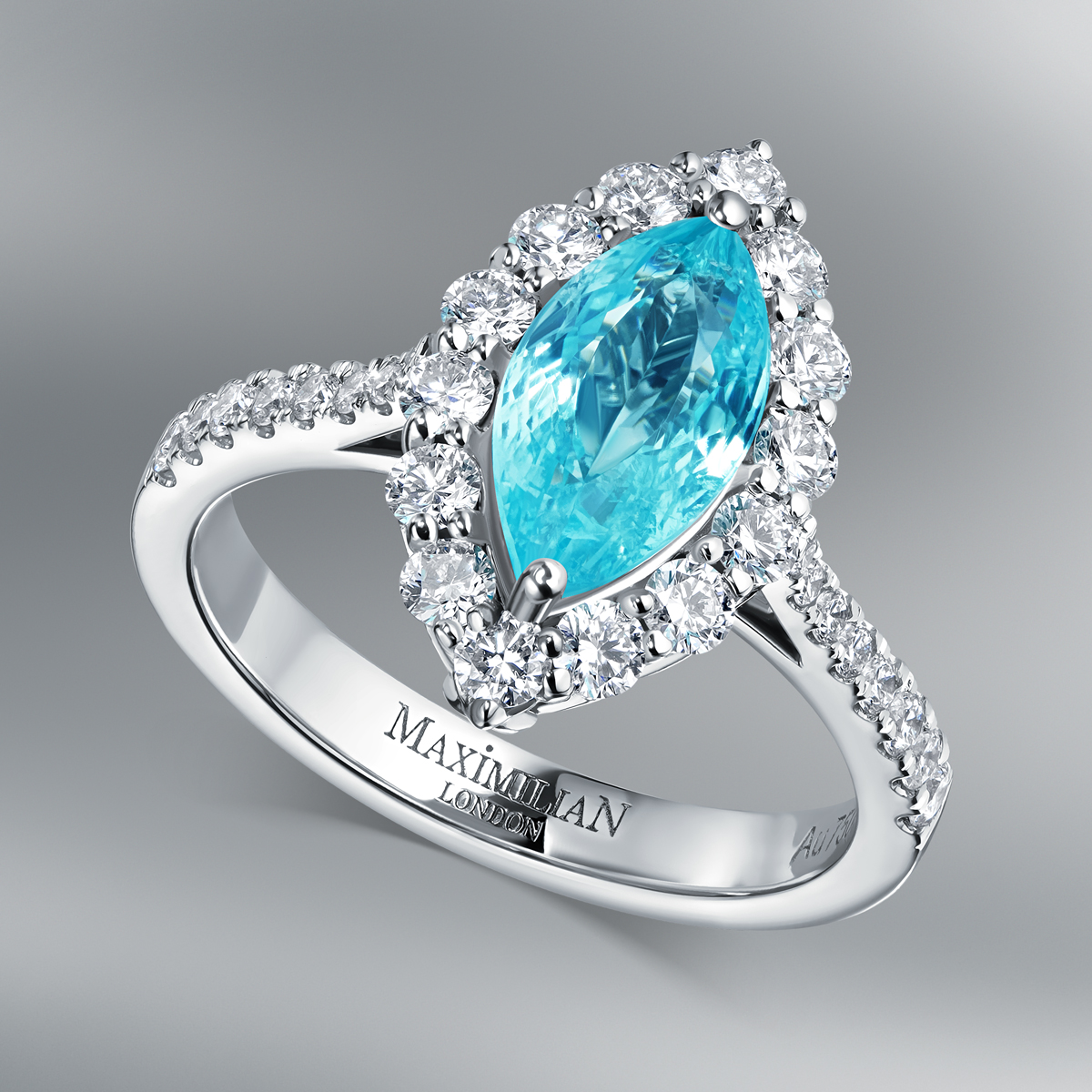
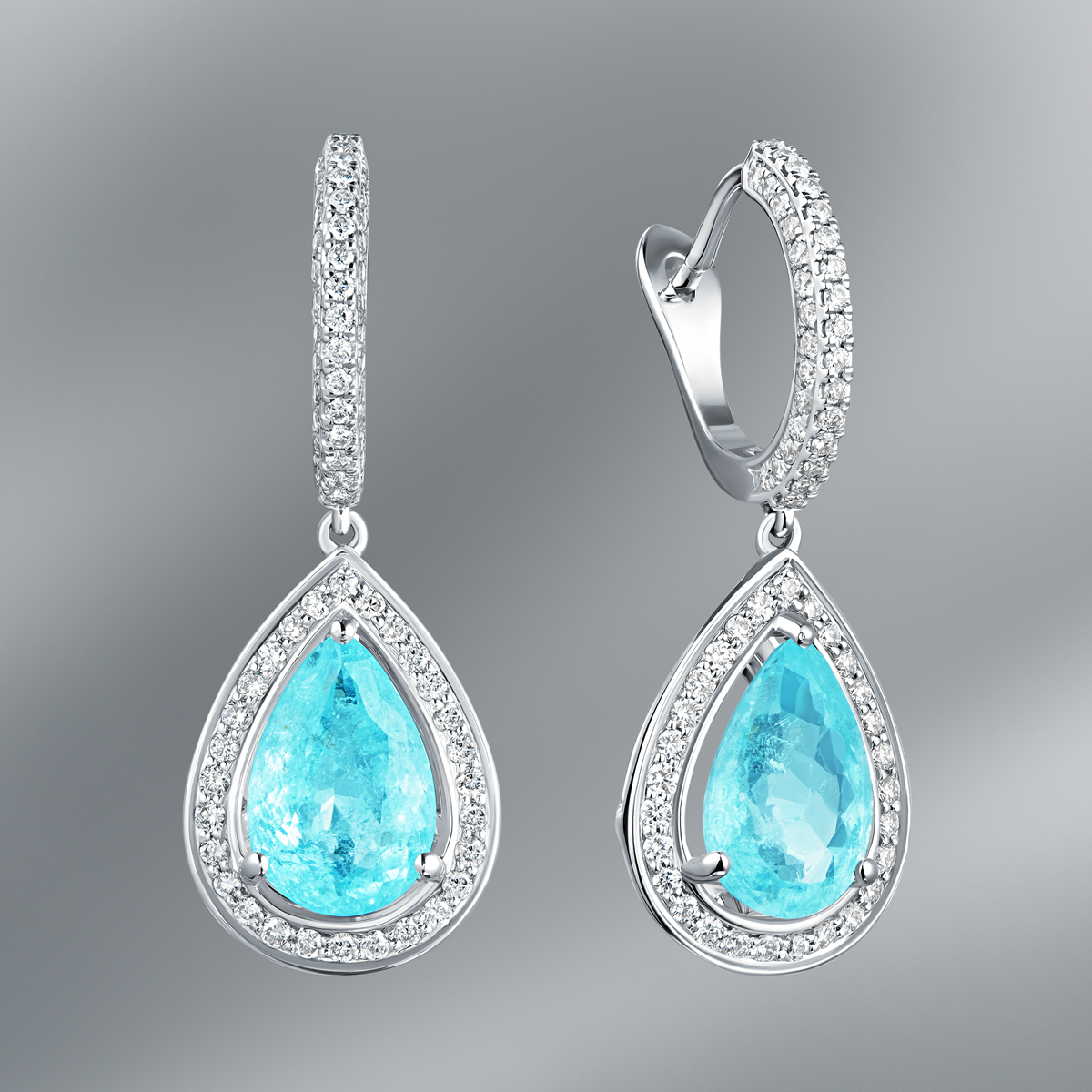
The two words meet naturally in the description of a jewel: a diamond ring set with Paraíba tourmaline, as in the pieces shown here. Read quickly, that description can collapse into what sounds like the name of a single stone.
The gemmological literature draws the line clearly. GIA describes Paraíba as a copper-bearing tourmaline variety, and the name is one the trade gives to copper and manganese bearing tourmaline. A diamond and a Paraíba tourmaline may share a setting, but they remain two different gems.
What Paraíba tourmaline is
Tourmaline is a complex boron-aluminium cyclosilicate. Paraíba-type stones are usually elbaite, one species within the tourmaline group, although liddicoatite examples also exist.
The first deposit was found in 1987 at Mina da Batalha, in the Brazilian state of Paraíba. The colour that made the gem famous is a bright blue caused by copper.
The definition widely accepted in the gem industry and at GIA covers blue (including electric blue, neon blue and violet blue), bluish green to greenish blue, and green (including yellowish green) tourmaline, of medium-light to high saturation and tone, mainly due to the presence of copper and manganese, regardless of geographical origin.
Paraíba does not always mean Brazil
Because the definition rests on colour and chemistry, the name is not a statement of origin. Copper-bearing tourmaline of this type is known from Nigeria and Mozambique as well as from localities in the Brazilian states of Paraíba and Rio Grande do Norte.
GIA research found that saturated blue-to-green stones from Nigeria and Mozambique cannot be distinguished from Brazilian material by standard gemological testing. Where geographic origin matters to a collector, a laboratory origin assessment can provide evidence beyond the trade name, although a definitive determination may not always be possible.
How Paraíba tourmaline differs from diamond
The differences are fundamental, and they begin with what each gem is made of.
- Composition: diamond is typically about 99.95 percent carbon; tourmaline is a complex boron-aluminium cyclosilicate.
- Crystal structure: diamond is isometric; tourmaline crystallizes in the trigonal system.
- Light: diamond is singly refractive; tourmaline is doubly refractive, with a birefringence listed by GIA as 0.018 to 0.040.
- Hardness: diamond rates 10 on the Mohs scale; tourmaline ranks 7 to 7.5.
- Blue colour: in Paraíba tourmaline it is caused by copper; in diamond the most common cause is boron in the crystal lattice, although colour can also be caused by radiation exposure or be associated with hydrogen.
Treatments to ask about
Heat treatment is part of this gem's story. In a GIA study of copper-bearing tourmaline from Mozambique, heating all but the green to yellowish green stones typically produced Paraíba-like blue-to-green hues.
Fractures in tourmaline can also be made less visible through filling with oils or resins. Neither practice can be judged from a description, which is why the laboratory document deserves a careful reading.
What to read on the report
A Paraíba tourmaline can be submitted to GIA for a Colored Stone Identification & Origin Report. GIA's reporting on tourmaline states whether the stone is natural or laboratory-grown and names any detectable treatments.
The principle in advertising is simple, and the Federal Trade Commission states it directly: claims about jewelry products must be accurate. If a jewel is offered under an unfamiliar name, the species stated on the report is the reliable reference.
Wearing and caring for the two gems
At 7 to 7.5 on the Mohs scale, tourmaline is markedly softer than diamond, and a ring set with both gems is best looked after with the tourmaline in mind.
GIA also notes that high heat can alter tourmaline's colour and that sudden temperature change can cause fracturing. Any repair that involves heat is therefore a matter for a jeweller who knows the stone is there.
Questions
Is a Paraíba diamond a real gemstone?
Paraíba is a variety of tourmaline. The definition accepted at GIA and in the gem industry applies to tourmaline, and diamond is a different mineral. The phrase is best read as a confusion of the two names.
Does Paraíba tourmaline always come from Brazil?
No. The name takes in copper and manganese bearing tourmaline of whatever geographical origin, and the material is also known from Nigeria and Mozambique.
What makes Paraíba tourmaline blue?
Its bright blue colour is caused by copper. Blue in diamond most commonly comes from boron in the crystal lattice.
Can a laboratory confirm that a stone is Paraíba tourmaline?
A Paraíba tourmaline can be submitted to GIA for a Colored Stone Identification & Origin Report, which also addresses whether the stone is natural and names any detectable treatments.
Sources
- Geographic Origin Determination of Paraíba Tourmaline, Gems & Gemology (GIA)
- Paraíba Tourmaline with Unusual Coating, Gems & Gemology (GIA)
- “Paraíba”-Type Copper-Bearing Tourmaline from Brazil, Nigeria, and Mozambique, Gems & Gemology (GIA)
- Copper-Bearing (Paraíba-Type) Tourmaline from Mozambique, Gems & Gemology (GIA)
- Field Gemology: Building a Research Collection, Gems & Gemology (GIA)
- Tourmaline Traits and Inclusions (GIA)
- Tourmaline (GIA)
- Tourmaline Care and Cleaning Guide (GIA)
- Diamond Description (GIA)
- Diamond Care and Cleaning Guide (GIA)
- Cloud Inclusions Causing Fancy Light Blue Color in Diamond, Gems & Gemology (GIA)
- The Magic of Colored Diamonds (GIA)
- Factors in Colored Stones that Interact to Affect Value (GIA)
- Colored Gemstone Value Factors (GIA)
- Does GIA Grade Tourmaline? (GIA)
- In the Loupe: Advertising Diamond, Gemstones and Pearls (Federal Trade Commission)
