

Bicolour tourmaline in an engagement ring
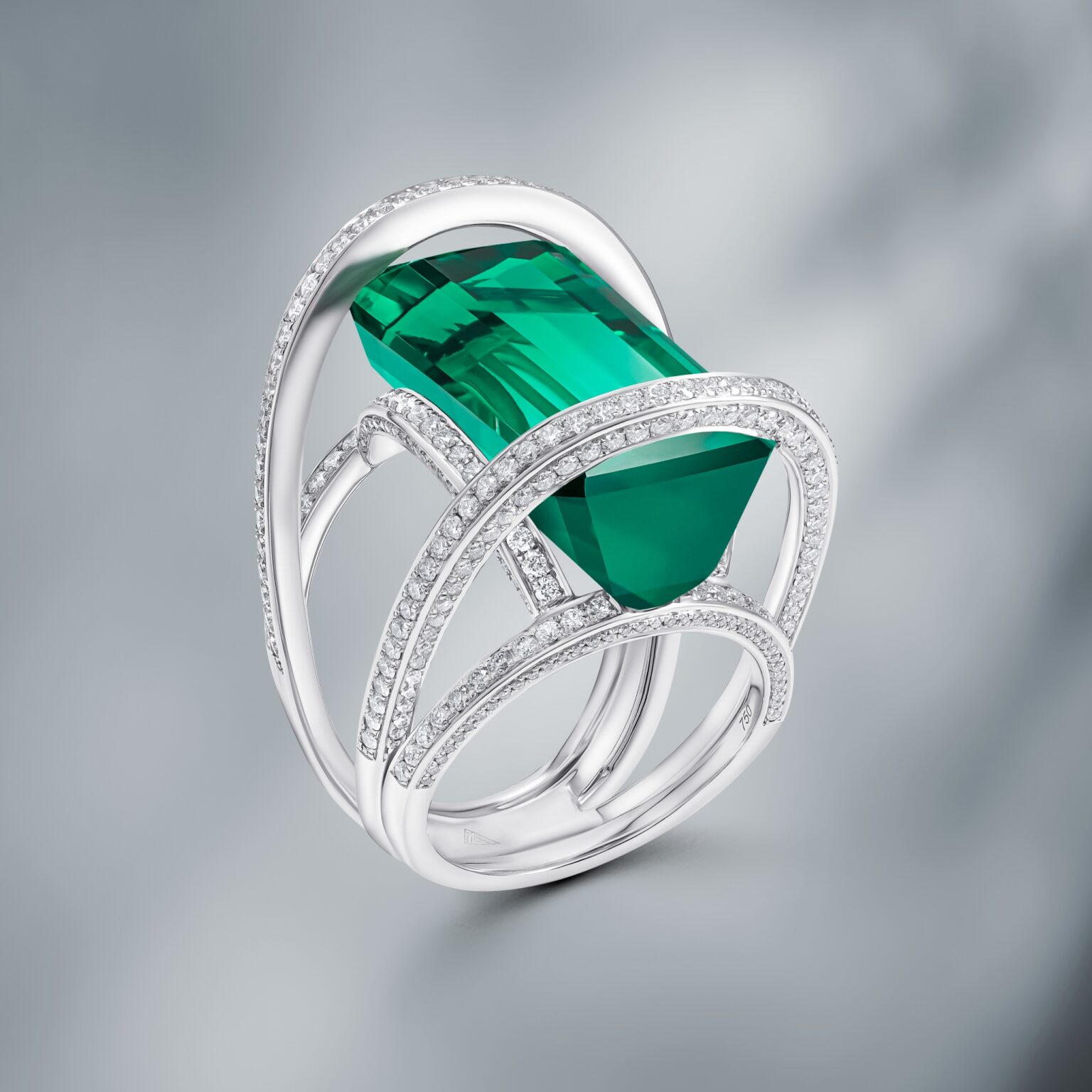
A bicolour tourmaline shows two colours in one crystal, because its trace-element chemistry changed while the crystal was growing. It ranks 7 to 7.5 on the Mohs scale, and its toughness is considered Fair, so in an engagement ring it rewards a protective setting and gentle care, away from heat and from ultrasonic and steam cleaners. Tourmaline has no laboratory-grown counterpart, and treatments are occasional and often undetectable, which is why a laboratory report that identifies the stone and lists detectable treatments matters.
One gem, a whole spectrum
Tourmaline is not a single mineral but a borosilicate mineral supergroup, with a trigonal crystal structure and a wide range of chemical compositions. More than 40 tourmaline species are recognised, and their highly variable chemistry gives rise to a wide range of colours. Traces of iron, and possibly titanium, are generally agreed to induce the greens and blues.
Most gem-quality tourmalines belong to one species, elbaite, which offers the widest range of gem colours. Tourmaline is common as a mineral, yet gem-quality stones are rare.
How two colours meet in one crystal
Tourmalines generally grow as elongated crystals and are often colour zoned. The zoning records the crystal's own history: bicolour, watermelon and multicolour stones form when the trace elements change in concentration or composition while the crystal is growing.
In watermelon tourmaline the colours are arranged from the centre outwards: green on the outside, pink on the inside. A bicolour stone brings two distinct colours together in a single gem.
How the cutter decides what you see
Tourmaline is one of the most strongly pleochroic gems: its colour changes with the direction in which it is viewed. The elongated shape of many crystals also has a direct impact on the finished gem's shape and proportions.
Orientation is therefore a deliberate choice. Rather than cutting every tourmaline lengthwise, many cutters orient a stone according to its depth of colour. In a bicolour gem, this choice decides how the two colours are presented face-up, as the stone will be seen on the hand.
Wearing it every day
Tourmaline ranks 7 to 7.5 on the Mohs hardness scale, which describes resistance to scratching. Its toughness, its resistance to chipping and breaking, is considered Fair, so a ring worn every day deserves protection from knocks.
It is generally stable to light and chemicals, but high heat can alter its colour and a sudden change of temperature can cause fracturing. Warm, soapy water is the best way to clean it; ultrasonic and steam cleaners are not recommended.
The setting does much of the protective work. Vulnerable points and corners are better protected with bezels, partial bezels or V-shaped prongs, and a bezel offers excellent protection for the edges of a stone. For an elongated bicolour gem worn daily, these are the questions to ask about the mounting.
Natural, treated, and the laboratory report
Tourmaline has no laboratory-grown counterpart: any tourmaline on the market, if it is indeed tourmaline, is natural. Treatment is a separate question. Tourmalines are occasionally treated, with pink stones irradiated to increase their saturation and blue and green stones given low-temperature heat treatment, and such treatments are often undetectable. Fracture filling has also been observed in tourmaline.
GIA examines coloured gemstones for heating, irradiation, fracture filling and other treatments. Its Colored Stone Identification Report identifies and describes the material and lists detectable treatments.
Where gem tourmaline comes from
Notable sources of gem tourmaline are Brazil, the United States, Madagascar, Nigeria and Mozambique. The Himalaya mine in Mesa Grande, California, produced a bicolour crystal specimen documented by GIA, and in a GIA study of tourmaline from Luc Yen, Vietnam, most of the elbaite and liddicoatite samples were multicoloured.
Questions
What is a bicolour tourmaline?
A tourmaline that shows two colours in one stone. The zoning forms when trace elements change in concentration or composition while the crystal is growing.
Is tourmaline hard enough for an engagement ring?
Tourmaline ranks 7 to 7.5 on the Mohs scale, and its toughness is considered Fair. For daily wear, a protective setting such as a bezel, partial bezel or V-shaped prongs helps guard vulnerable edges and corners. Keep the ring away from heat and clean it with warm, soapy water rather than ultrasonic or steam cleaners.
Can a tourmaline be laboratory-grown?
No. Tourmaline has no laboratory-grown counterpart, so a genuine tourmaline is natural. It may still have been treated, which is a separate question.
Is bicolour tourmaline treated?
Tourmalines are occasionally treated by irradiation or low-temperature heating, and such treatments are often undetectable. A GIA Colored Stone Identification Report identifies the stone and lists detectable treatments.
Sources
- Micro-Features of Tourmaline, Gems & Gemology (GIA)
- G&G in a Flash: Micro-Features of Tourmaline (GIA)
- Tourmaline Description (GIA)
- GIA Gem Project: Tourmaline (GIA)
- Tourmaline (GIA)
- Tourmaline Quality Factors (GIA)
- Tourmaline Care and Cleaning (GIA)
- Tourmaline Buyer's Guide (GIA)
- An Introduction to Pleochroism in Faceted Gems, Gems & Gemology (GIA)
- Which Treatments Does GIA Test For? (GIA)
- Unmasking Emerald Filler, Gems & Gemology (GIA)
- Tourmaline History and Lore (GIA)
- Tourmaline from Luc Yen, Vietnam, Gems & Gemology (GIA)
- Colored Stone Reports (GIA)
- More Than Mohs: Gem Durability (GIA 4Cs)
- Guide to Ring Settings (GIA 4Cs)
