

Royal blue and cornflower blue sapphire: what the colour terms mean
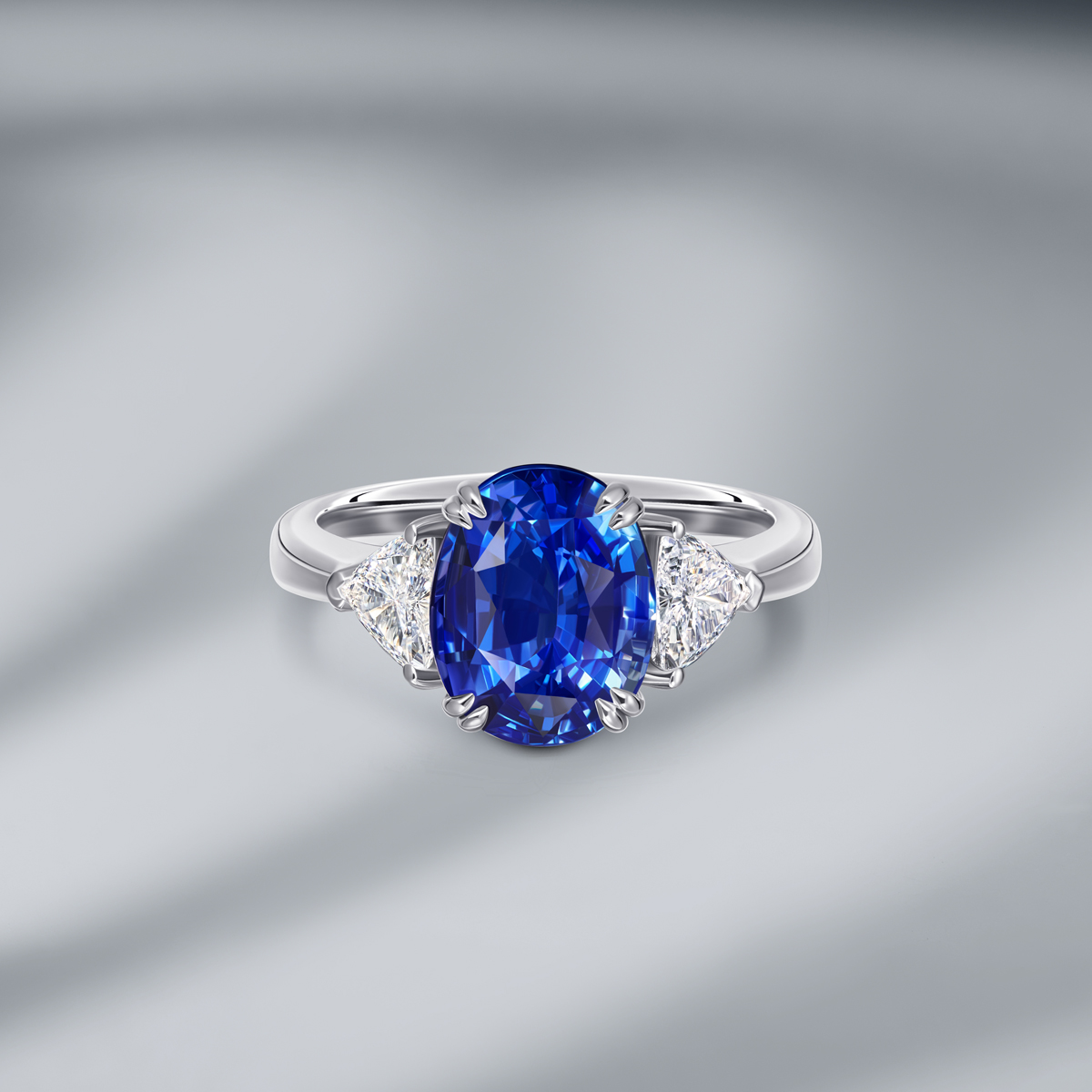
Royal blue and cornflower blue are trade colour terms for the finest blue sapphires, not scientific grades. Royal blue describes a deeply saturated blue, pure or with a very slight purplish tint. Cornflower blue describes a saturated blue in a lighter, light to moderate tone, possibly with a gentle hint of violet. Each laboratory applies its own criteria: SSEF and Gübelin give royal blue only to untreated sapphires, Gübelin's Cornflower Blue also excludes any treatment, while GRS has also applied royal blue to heated sapphires.
Two names for the finest blue
Blue sapphire belongs to the mineral species corundum. Its blue requires the interaction of two trace elements, iron and titanium.
Royal blue and cornflower blue are names the trade gives to the most admired shades of that blue. SSEF states that royal blue is a trade colour term without a scientific (colorimetric) definition, and that no international standard has been established for it to date. Gübelin adds that there are no universally accepted definitions of the colour and quality criteria a gemstone must meet for such designations.
What GIA considers the finest blue
According to GIA, the most highly valued blue sapphires are velvety blue to violetish blue, in medium to medium dark tones. In general, the more intense and uniform the colour, the more valuable the stone.
Uniformity matters because blue sapphire often has angular zones of blue and lighter blue. GIA also notes that many of the most valuable Kashmir sapphires contain tiny inclusions that give them a velvety appearance.
Royal blue: a deep, saturated blue
Gübelin explains that royal blue was originally used to describe high-quality blue sapphires from Burma (Myanmar) with a deeply saturated blue, sometimes with a minute hint of purple.
SSEF describes royal blue as a blue of strong saturation, either pure or with a very slight purplish tint. It grades colour by comparison with a masterset of natural sapphires, observing hue, saturation and brightness, and does not accept an additional greenish or greyish tint. Gübelin requires an intense, saturated and homogeneous blue, and the two laboratories agreed in 2015 to harmonise their definitions and testing procedures for the term.
Beyond colour, Gübelin expects a royal blue sapphire to be relatively free of eye-visible or dark inclusions, with homogeneous colour and vivid internal reflections. Size is not a criterion: small sapphires may also qualify.
Cornflower blue: a lighter, luminous blue
The name is inspired by the blue of the cornflower. Gübelin notes that it has long been used in the trade, although interpretations of its exact definition vary.
From 1 January 2027, Gübelin will offer Cornflower Blue as a trade colour on its reports for natural blue sapphires of exceptional colour and visual quality. Its definition is a saturated blue with a light to moderate tone, possibly with a gentle hint of violet.
- No signs of treatment, including heat or clarity enhancement.
- Homogeneous colour distribution.
- A high level of transparency; a slight velvety appearance is welcome, though not compulsory.
- No eye-visible inclusions and no dark inclusions.
The difference in one line
Both terms describe a saturated blue. Royal blue sits in the deeper register, with a very slight purplish tint at most. Cornflower blue sits in a lighter, light to moderate tone, with at most a gentle hint of violet. Neither is a grade, and one is not simply a better version of the other.
Gübelin expects only a small proportion of blue sapphires to meet all of its Cornflower Blue criteria.
Origin is not the test
Royal blue was historically coined for the finest sapphires from the Mogok area in Burma. SSEF also applies it to sapphires from other metamorphic deposits, such as Madagascar, Sri Lanka and Kashmir.
Gübelin's Cornflower Blue is independent of geographical origin and is assessed on the individual stone. GRS grants royal blue to sapphires of any origin that fit its colour standards, although basaltic-type sapphires do not qualify.
Treatment: where laboratories differ
GIA states that heating is an accepted treatment for sapphire, and that heating can intensify, or even induce, a blue coloration. It is the most common process used to improve colour.
SSEF and Gübelin reserve royal blue for untreated sapphires, and Gübelin's Cornflower Blue also requires no signs of treatment. GRS takes another view: it has published royal blue reports for heated as well as unheated sapphires, and lists intense to vivid and vivid to deep blue among its GRS-type royal blue categories.
How to read the term on a report
GIA does not grade or provide quality analysis for sapphire. A GIA coloured stone report identifies and describes the material and lists detectable treatments, so a colour term on a report comes from the laboratory that chose to apply one.
- Laboratory: which one issued the term, since each defines it in its own way.
- Treatment: untreated, or heated, as stated in the report.
- Colour: deep and saturated for royal blue, lighter and luminous for cornflower blue.
- The stone itself: an even, lively blue seen in person, not the words alone.
Questions
Is cornflower blue the same as royal blue?
No. Both describe a saturated blue, but royal blue is deeper, pure or with a very slight purplish tint, while cornflower blue has a lighter, light to moderate tone, possibly with a gentle hint of violet.
Which colour of blue sapphire is best?
According to GIA, the most highly valued blue sapphires are velvety blue to violetish blue, in medium to medium dark tones, and the more intense and uniform the colour, the more valuable the stone.
Is royal blue an official sapphire grade?
No. SSEF states that royal blue is a trade colour term without a scientific (colorimetric) definition and that no international standard has been established for it. Each laboratory applies its own criteria.
Does royal blue mean the sapphire is from Burma?
Not today. The term was historically coined for the finest sapphires from Mogok in Burma, but SSEF also applies it to sapphires from Madagascar, Sri Lanka and Kashmir, and GRS grants it regardless of origin.
Can a heated sapphire be called royal blue?
It depends on the laboratory. SSEF and Gübelin give the term only to untreated sapphires. GRS has published royal blue reports for both heated and unheated sapphires.
Sources
- Sapphire Description (GIA)
- Sapphire Quality Factors (GIA)
- Sapphire Buyer's Guide (GIA)
- Does GIA Grade Sapphires? (GIA)
- Heat Treatment and Sapphire (GIA)
- Gem Treatment (GIA)
- Colored Stone Reports (GIA)
- Geographic Origin Determination of Gemstones (Gems & Gemology, GIA)
- Inclusions in Sapphire (Gems & Gemology, GIA)
- Colour Terms: Pigeon Blood Red and Royal Blue (SSEF)
- Gemstone Colour Terms (Gübelin Gem Lab)
- Cornflower Blue, a New Trade Colour (Gübelin Gem Lab)
- Colour Grading (GRS)
- Pigeon's Blood and Royal Blue (GRS)
- Royal Blue Sapphires from Diverse Origins (GRS)
