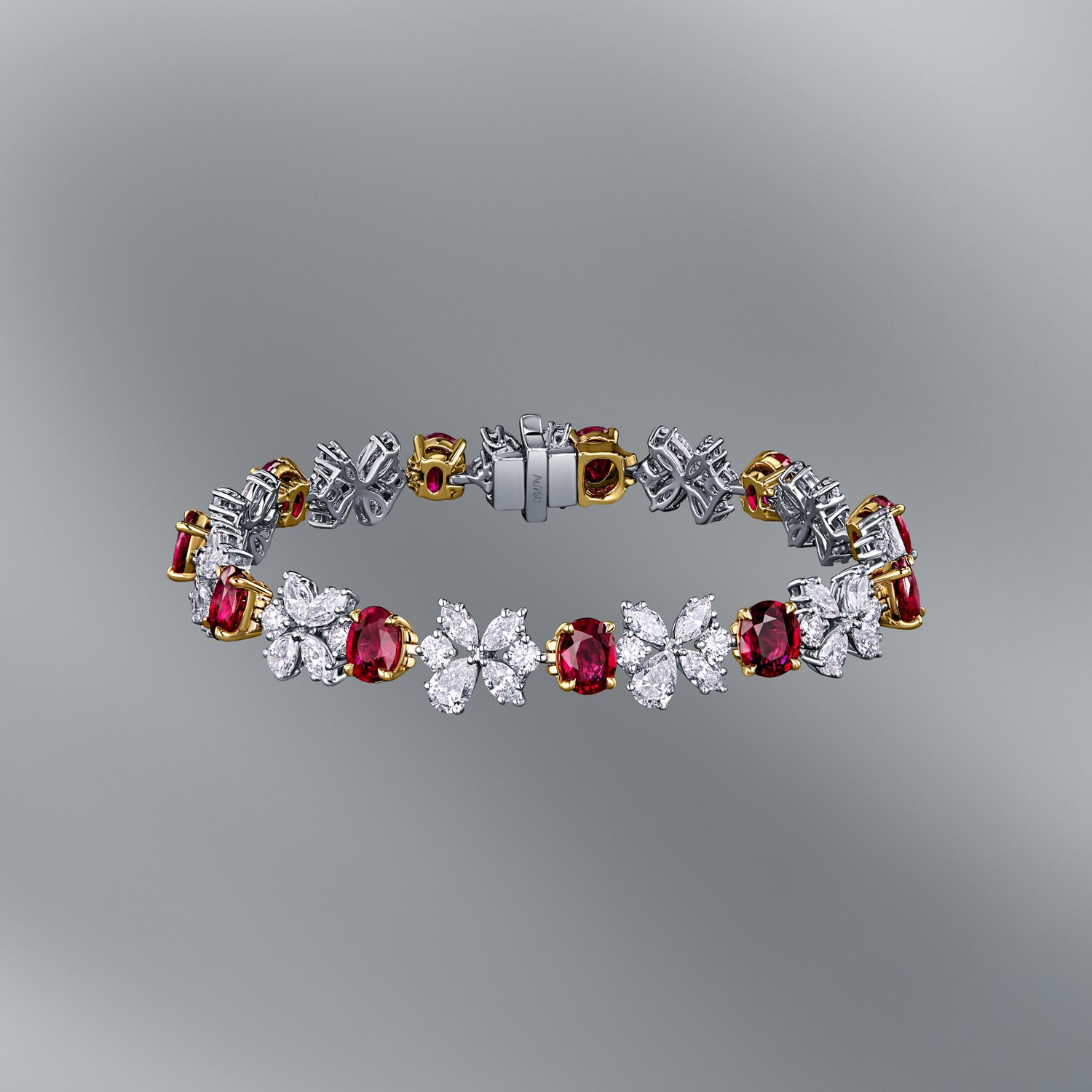
Pigeon blood ruby: what the term means and how laboratories apply it

Pigeon blood is a trade colour term for the finest red in ruby, traditionally used for the best Burmese (Myanmar) stones. It has no scientific colorimetric definition and no international standard, so each laboratory applies its own criteria: an intense, saturated red, usually with strong fluorescence, and at SSEF and Gübelin no treatment of any kind. On a laboratory report, the term should be read according to the criteria of the laboratory that issued it.
A trade name for the finest red
The expression has long pedigrees. GRS notes that it was traditionally used to describe the finest colours found in Burmese (Myanmar) ruby.
It is not a scientific grade. SSEF states that pigeon blood red is a trade colour term without a scientific (colorimetric) definition, and that no international standard has been established for it to date.
Where the red of a ruby comes from
Ruby is the red variety of corundum. According to GIA, chromium is the trace element that causes its red, which ranges from an orangy red to a purplish red.
Chromium can also cause fluorescence, which adds to the intensity of the red colour. This is why fluorescence matters so much in the laboratories' definitions of pigeon blood.
In GIA's words, the finest ruby has a pure, vibrant red to slightly purplish red colour.
How SSEF applies the term
When SSEF assesses a colour term, it observes three main parameters: hue, saturation and brightness.
The body colour of a pigeon blood red ruby must be complemented by strong fluorescence under ultraviolet light. SSEF gives the term only to rubies that show no indications of any treatment, and geographic origin is not one of its criteria.
How Gübelin applies the term
At Gübelin Gem Lab, a ruby's colour must be an intense, saturated and homogeneous red to qualify for the term.
Any treatment, including heating or fissure filling, disqualifies a ruby from receiving the designation.
How GRS applies the term
GRS describes its pigeon blood Type 1 as rubies with medium-strong to strongly saturated vivid red hues and medium to strong fluorescence under UV light (365 nm).
In 2012 GRS added Type 2 for rubies with the correct vivid red colour but less than medium-strong fluorescence. Such stones receive an appendix to the GRS report with a qualified comparison; GRS's sample comment reads that a vivid red Mozambican ruby is reminiscent in colour saturation of a pigeon blood ruby, without strong fluorescence.
Unlike SSEF and Gübelin, GRS applies its grade independently of origin to both heated and unheated rubies. It does not grant the label to lead-glass-treated (hybrid) rubies, among other categories.
Not only a Burmese name today
The term was traditionally associated with the finest Burmese (Myanmar) rubies, but its use today is not restricted to that origin. SSEF states that geographic origin is not a criterion, and GRS applies its grade independently of origin.
A pigeon blood ruby may therefore come from more than one source. Origin, when it matters to you, is a separate opinion on the report.
Treatment: the line that decides
GIA notes that most ruby has been heated, and that some gems on the market have had colour diffused into the surface or fractures filled with lead glass to improve their appearance.
A GIA coloured stone report identifies and describes the material and lists detectable treatments. GIA evaluates ruby but does not grade it, so the colour term itself comes from the laboratory that chose to apply one.
How to read pigeon blood on a report
The same red can be called pigeon blood by one laboratory and not by another, because the criteria differ. Read the term together with the name of the laboratory and the treatment line of the report.
- Laboratory: which one issued the term, since each defines it differently.
- Treatment: no indications of treatment, or heating, as stated in the report.
- Fluorescence: SSEF expects strong fluorescence, while GRS Type 2 covers vivid red rubies with weaker fluorescence.
- The stone itself: a pure, vibrant red seen in person, not the words alone.
Questions
Why is ruby called pigeon blood?
It is a historic trade name. According to GRS, the term was traditionally used to describe the finest colours found in Burmese (Myanmar) ruby.
Is pigeon blood an official ruby grade?
No. SSEF states that pigeon blood red is a trade colour term without a scientific (colorimetric) definition, and that no international standard has been established for it. Each laboratory applies its own criteria.
How can I tell if a ruby is pigeon blood?
Not by eye alone. The term appears on a report from a laboratory that assesses colour against its own criteria: an intense, saturated red, usually with strong fluorescence, and at SSEF and Gübelin no treatment of any kind.
Does pigeon blood mean the ruby is from Burma?
Not today. The term was traditionally associated with Burmese rubies, but SSEF states that geographic origin is not a criterion, and GRS applies its grade independently of origin.
Can a heated ruby be called pigeon blood?
It depends on the laboratory. SSEF and Gübelin give the term only to rubies with no indications of treatment. GRS applies it to heated and unheated rubies, but not to lead-glass-treated ones.