

Fancy colour diamonds: how to read the colour grade
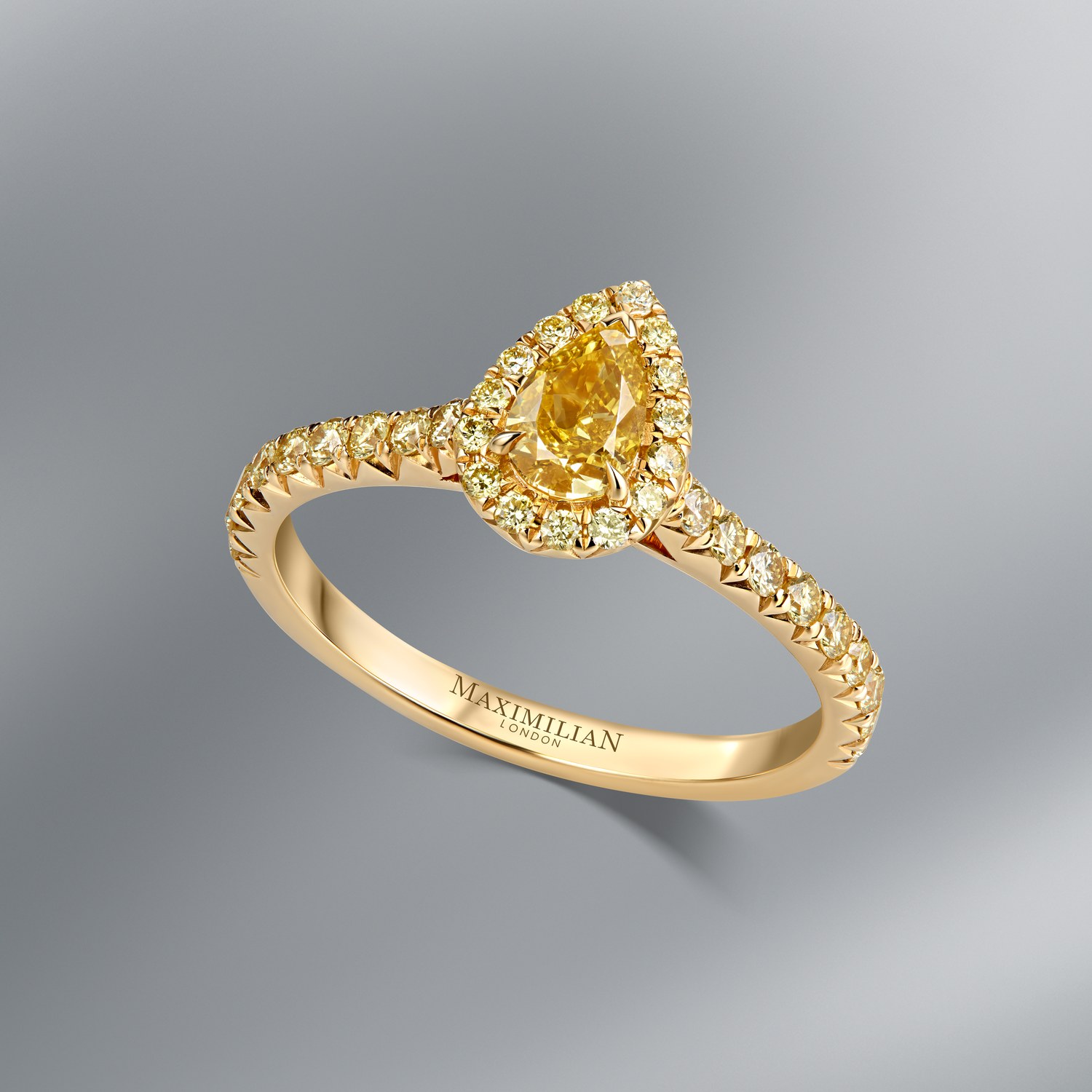
A fancy colour diamond is a diamond whose colour falls outside GIA's D-to-Z scale. The D-to-Z scale grades the absence of colour; fancy colour grading assesses its presence, through hue, tone and saturation, viewed face-up. The grade combines a term such as Fancy Light, Fancy Intense or Fancy Vivid with a colour description in which the final word names the dominant hue. Whether the colour is natural or treated is stated in a separate line of the GIA report: colour origin.
Beyond the D-to-Z scale
When a diamond falls outside GIA's D-to-Z colour scale, it is considered a coloured diamond, often called a fancy colour diamond.
The two systems look at colour in opposite ways. The D-to-Z scale is based on the relative absence of colour. Fancy colour grading is based on its presence: the question is no longer how little colour a stone shows, but what colour it is and how strongly it shows it.
Hue, tone and saturation
GIA describes the colour of a coloured diamond through three components.
- Hue: the characteristic colour, such as yellow, pink or blue.
- Tone: the relative lightness or darkness of the colour.
- Saturation: the depth or strength of the colour.
The nine grade terms
GIA grades coloured diamonds with nine terms: Faint, Very Light, Light, Fancy Light, Fancy, Fancy Intense, Fancy Dark, Fancy Deep and Fancy Vivid.
The term alone does not tell the whole story. It is always read together with the colour description that follows it, as in Fancy Intense orangy yellow or Fancy Vivid blue.
How to read the colour description
Many coloured diamonds show more than one hue, and the report names them in a set order: the final word of the colour description is the dominant hue. In an orangy yellow diamond, yellow dominates and orange modifies it. GIA's descriptions of pink diamonds include purplish pink and pinkish purple, two different colours in which the dominant hue changes places.
A modifier is not a mark against a stone. In GIA's words, a modifier does not indicate that the colour is any less strong or pure.
What gives a diamond its colour
Different defects and processes within the diamond crystal can produce colour. A single colour may have more than one possible cause, and identifying that cause is part of laboratory analysis.
- Yellow and orange: nitrogen impurities incorporated into the diamond lattice during growth deep in the earth. Isolated nitrogen is one of the forms that produces yellow.
- Blue: most commonly boron in the crystal lattice. Such diamonds are classified as type IIb.
- Pink: in most pink diamonds the colour is associated with plastic deformation, and it often concentrates along slip planes and graining inside the stone.
- Green: exposure to radiation, which may be natural or carried out in a laboratory.
Why the cut matters
Coloured diamonds are graded face-up, because the grading system is based on the presence of colour when the diamond is viewed from that position.
The cut therefore shapes what the grader sees. GIA notes that cutters discovered certain styles, typically mixed cuts such as the Radiant, can intensify yellow colour in diamonds. This is why a coloured diamond is best judged face-up, as it will be worn.
Colour origin: natural, treated or undetermined
Colour can also be introduced or changed after a diamond leaves the earth. GIA describes HPHT treatment as using machines essentially the same as those used to grow diamonds in a laboratory. Laboratory-grown diamonds can be coloured as well: adding boron during growth produces blue crystals, and other colours can be produced by treatment after growth.
Distinguishing natural diamonds from laboratory-grown diamonds, and natural colour from treated colour, may require advanced analytical testing or examination by a gemmological laboratory. The GIA Colored Diamond Grading Report includes the colour grade and the colour origin, natural or treated. The GIA Colored Diamond Identification and Origin Report describes colour origin for natural coloured diamonds, whether loose or mounted, and includes a colour grade for loose stones.
Where current testing cannot positively determine the source of colour, GIA notes the colour origin as undetermined. GIA does not issue grading reports for diamonds with nonpermanent or unstable treatments, such as coating or fracture filling.
Questions
What is a fancy colour diamond?
A diamond whose colour falls outside GIA's D-to-Z scale. Its grade describes the presence of colour, through hue, tone and saturation, rather than its absence.
What do Fancy Intense and Fancy Vivid mean?
They are two of the nine grade terms GIA uses for coloured diamonds, alongside Faint, Very Light, Light, Fancy Light, Fancy, Fancy Dark and Fancy Deep. Each is read together with the colour description, for example Fancy Vivid yellow.
In "orangy yellow", which colour dominates?
Yellow. In a GIA colour description the final word names the dominant hue, and the word before it is a modifier.
How can I know whether the colour is natural?
From the laboratory report. The GIA Colored Diamond Grading Report states the colour origin, natural or treated. When testing cannot determine the source of colour, GIA notes it as undetermined.


Sources
- When Is a Colored Diamond Considered Fancy? (GIA)
- How Does Colored Diamond Grading Differ from D-to-Z Grading? (GIA)
- Types of GIA Reports (GIA 4Cs)
- How to Choose a Yellow Diamond Engagement Ring (GIA 4Cs)
- Natural-Color Pink, Purple, Red, and Brown Diamonds, Gems & Gemology (GIA)
- Naturally Colored Yellow and Orange Gem Diamonds, Gems & Gemology (GIA)
- Patchy Yellow Trigon, Gems & Gemology (GIA)
- Cloud Inclusions Causing Blue Color in Diamond, Gems & Gemology (GIA)
- Diamonds with 480 nm Band, Gems & Gemology (GIA)
- Diamond Reflections, Gems & Gemology (GIA)
- Green Diamonds (GIA 4Cs)
- Fancy Color Diamond Buyer's Guide (GIA)
- Diamond Color: Seven Things You Need to Know (GIA 4Cs)
- Sample Report: Colored Diamond Grading Report (GIA)
- Colored Diamond Reports (GIA)
- Changing a Diamond's Color (GIA 4Cs)
- What Diamond Treatments Mean (GIA 4Cs)
- Diamond Treatments (GIA 4Cs)
- HPHT and CVD Diamond Growth Processes (GIA)
- GIA Update on Laboratory-Grown Diamonds, Gems & Gemology (GIA)
